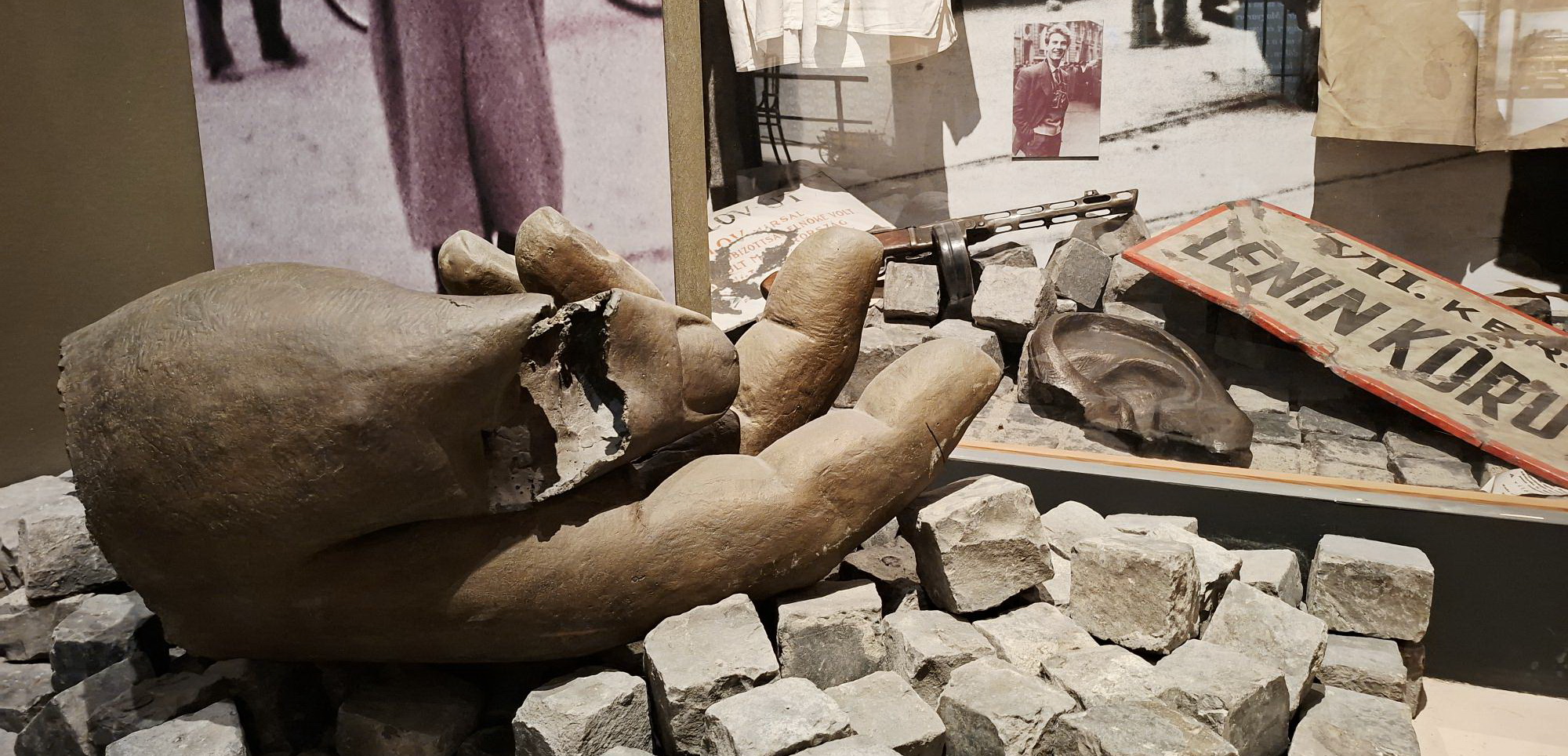
Written by Yavor Tarinski. Cover image of the publication: Remnants of Stalin’s statue in Budapest that was toppled by the people on 23 of October, 1956 (Exhibited at Hungarian National Museum).
I’m in Budapest on the occasion of the 70th anniversary from the 1956 people’s uprising against Soviet despotism. The anniversary has marked the life in the Hungarian capital these days as various commemorations are taking place literally at every corner of the city. The State apparatus, along with various political forces, all try to tap on the 1956 legacy, attempting to channel its significations through their prisms and for their own political goals. This makes the the memory of the uprising a heavily contested territory. But despite everything, fragments of this not-so distant past remain visible and speak for themselves.
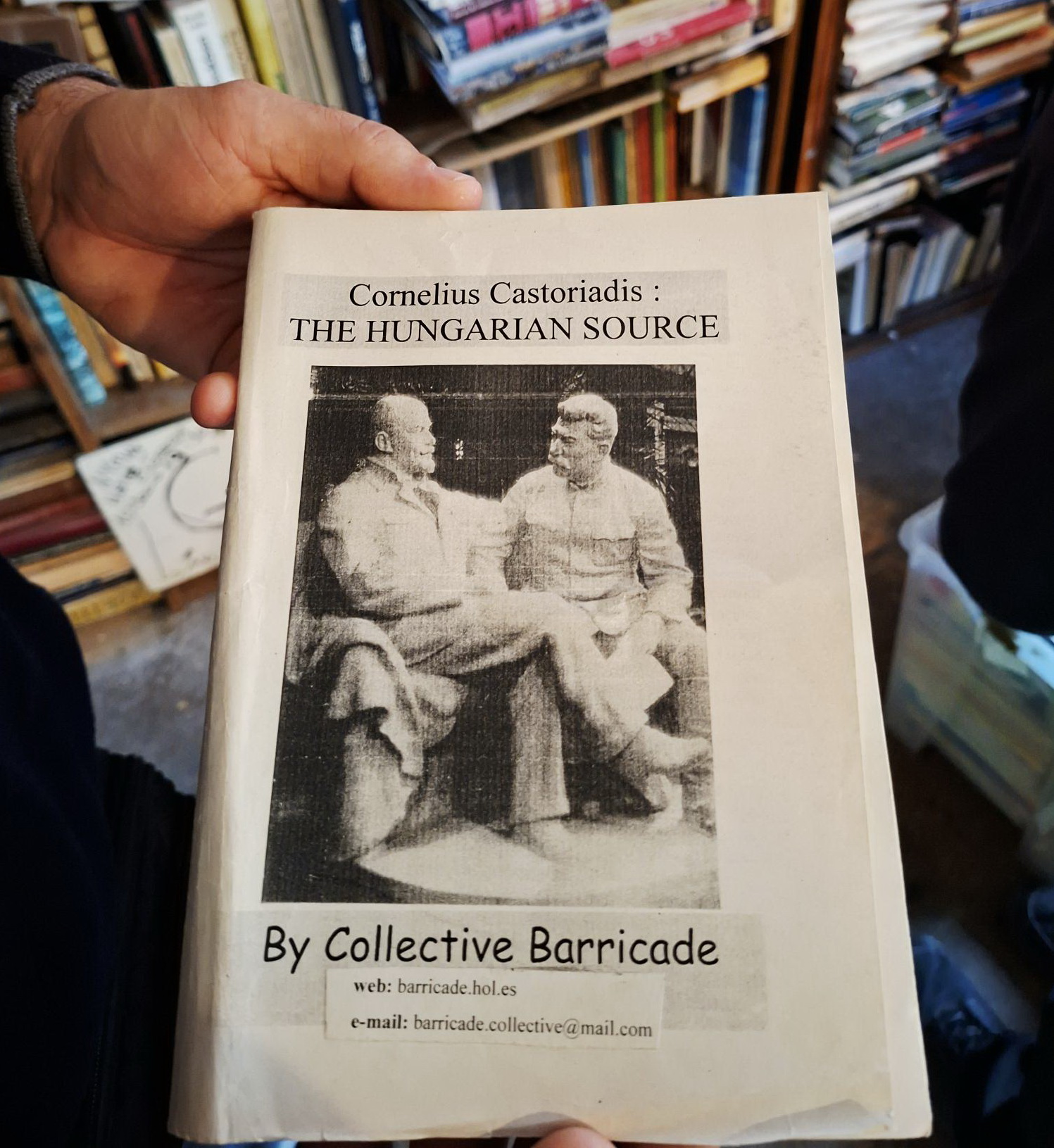
One of the defining features of the revolt was the emergence of workers’ councils that refuted Bolshevik centralism from a socialist and autonomous perspective, challenging Cold War narratives that viewed capitalism and authoritarian communism as the only models capable of mobilizing people en masse. Rather than choosing between the false dichotomy of capitalist individualism versus state-sanctioned equality, the 1956 Budapest uprising showed once again that individual toilers were capable of self-empowering themselves to self-manage everyday life for the common good and collectively set up their own agendas. Because of this the revolt got the support of thinkers like Cornelius Castoriadis, CLR James, Hannah Arendt, and others, who were firm believers in the democratic potential of the grassroots.
In contrast to the claims of the then ruling Communist Party elite that slandered the rebellious multitude as being engulfed by counter-revolutionary nationalism, or pro-Western commentators that imagined the uprising as a popular strife towards capitalism, the deliberative organs of the people challenged the state-communist system from an anti-capitalist and autonomous position. It is also significant to underline the fact that these councils forged federative networks with each other in order to coordinate their struggle and to organize the self-management of Budapest.
It is particularly important that announcements and declarations issued by the very workers’ councils in that emerged during the days of the 1956 uprising were preserved by ordinary citizens, often at very high personal risk, in order to showcase their autonomous legacy. Allowing the wider public to have access to such artifacts is immensely important as it allows us a direct and unmediated look at the moments when the grassroots undertook an autonomous role in shaping their destiny, rather them being channeled to us through the lens of bureaucratic party apparatuses of all colors, power-hungry oligarchs, and official state institutions.
And while such documents are often embedded in exhibitions in national museums and galleries to serve a purpose in the national narrative, their words nonetheless remain carriers of significations forged in bursts of democratic creativity from below. One such case is the following declaration, issued by several workers’ councils in October 1956, exhibited at the Hungarian National Library as part of an important 2026 exhibition with secretly kept amateur photos from the uprising.
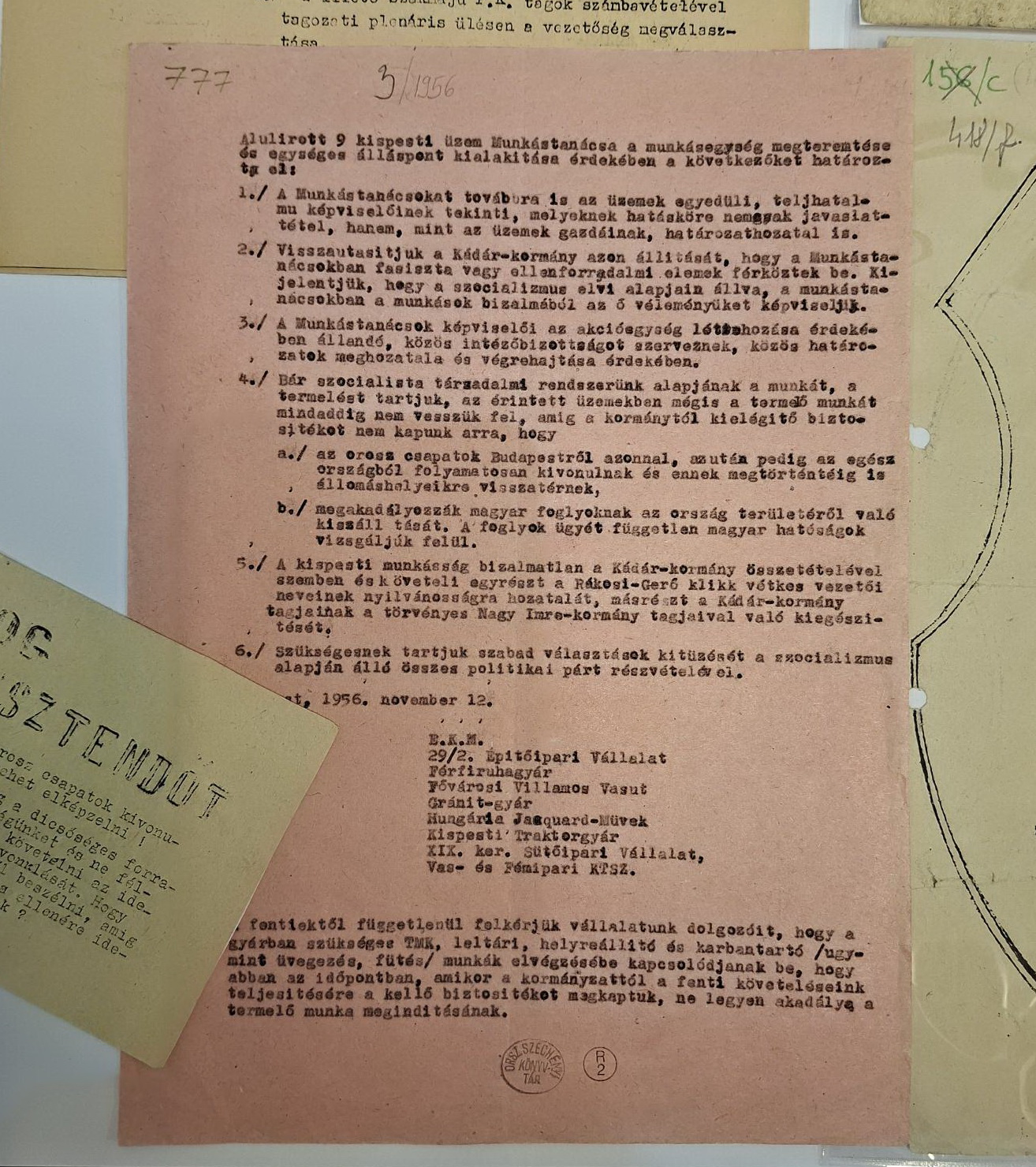
English Translation:
The undersigned Workers’ Councils of 9 factories in Kispest, in order to create unity of action and establish a unified position, decide as follows:
1. We continue to regard the Workers’ Councils as the sole, fully-empowered representatives of the factories, whose scope of authority includes not only making proposals, but also making decisive resolutions as owners of the factories.
2. We reject the assertion of the Kádár government that fascist or counter-revolutionary elements have infiltrated the Workers’ Councils. We declare that, standing on the ideological principles of socialism, the Workers’ Councils represent the workers’ opinion with their trust.
3. The representatives of the Workers’ Councils shall organize a permanent, joint executive committee in order to establish unity of action, to make joint decisions, and to execute them.
4. Although we consider labor and production to be the basis of our socialist social system, we will nevertheless not resume productive work in the affected factories until we receive satisfactory guarantees from the government that:
a) Russian troops immediately withdraw from Budapest, and subsequently continuously withdraw from the entire country, and until this is completed, return to their stations; b) they prevent the deportation of Hungarian prisoners from the territory of the country. The cases of prisoners must be reviewed by independent Hungarian authorities.
5. The workers of Kispest distrust the composition of the Kádár government and demand, on the one hand, the public disclosure of the names of the guilty leaders of the Rákosi–Gerő clique, and on the other hand, the supplementation of the members of the Kádár government with members of the lawful Imre Nagy government.
6. We consider it necessary to set free elections with the participation of all political parties standing on the basis of socialism.
Oct. 12, 1956.
Signatories / Represented Organizations:
• E.K.M.
• 29/2. Építőipari Vállalat (Construction Enterprise No. 29/2)
• Férfiruhagyár (Men’s Clothing Factory)
• Fővárosi Villamos Vasút (Capital City Electric Railway)
• Gránit-gyár (Granite Factory)
• Hungária Jacquard-Művek (Hungaria Jacquard Works)
• Kispesti Traktorgyár (Kispest Tractor Factory)
• XIX. ker. Sütőipari Vállalat (District XIX Baking Industry Enterprise)
• Vas-és Fémipari KTSZ (Iron and Metal Industry Workers’ Co-operative)
Regardless of the above, we request the workers of our enterprises to join in at this time—so that when we have received adequate guarantees from the government for the fulfillment of our above demands, there will be no obstacle to the resumption of productive work—for the execution of necessary TMR (planned preventive maintenance), inventory, restoration, and maintenance work (such as glazing and heating).
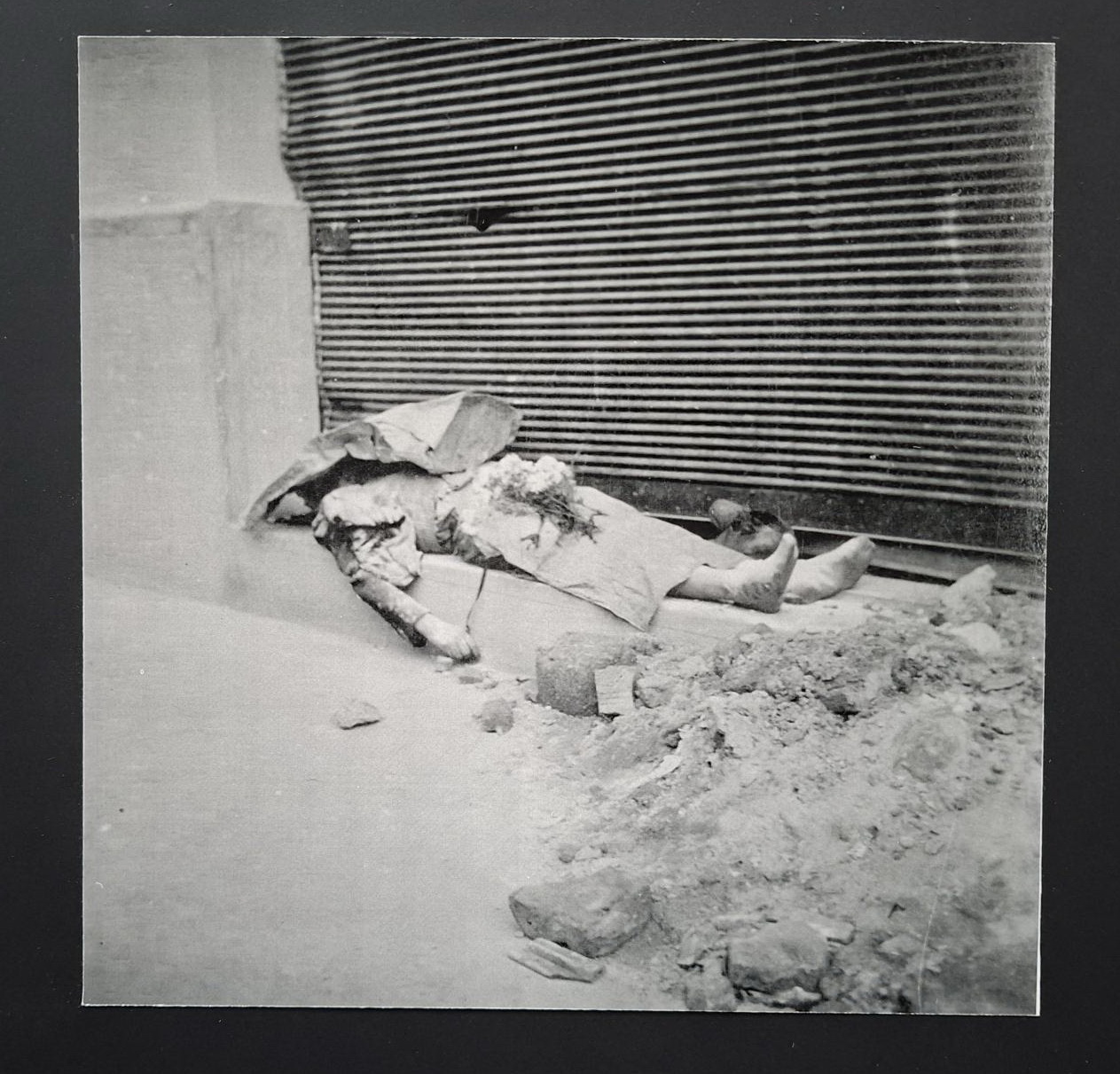
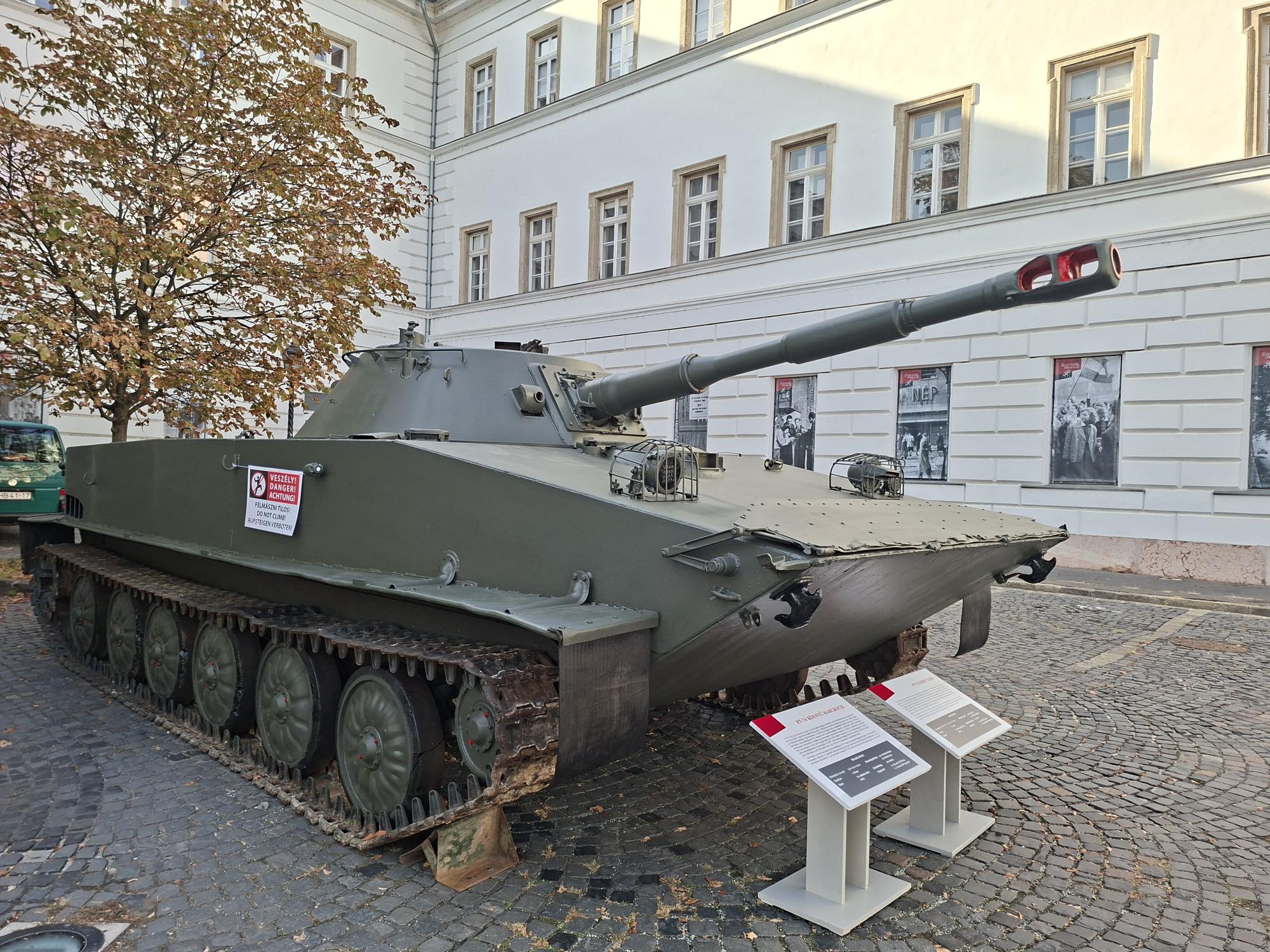
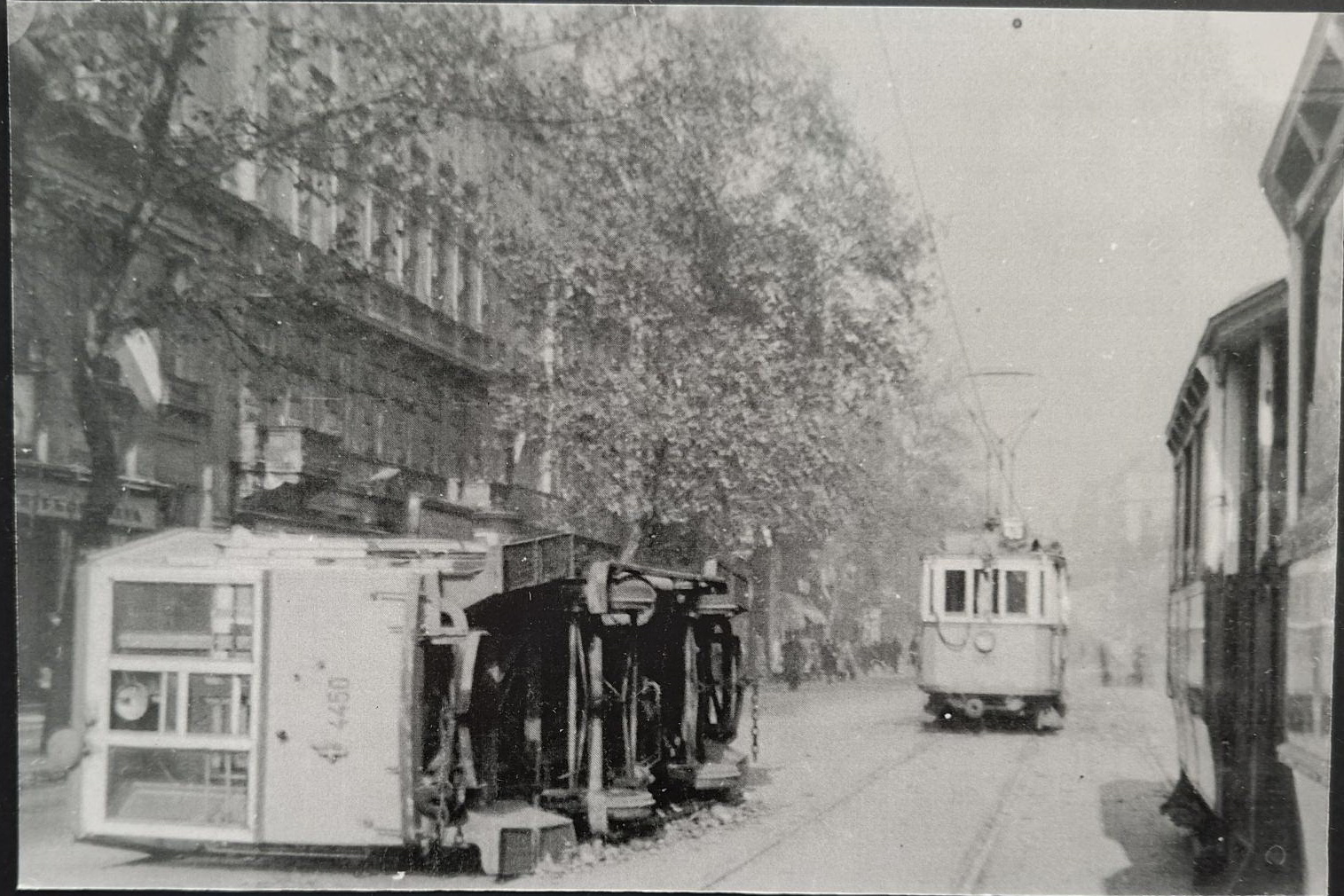
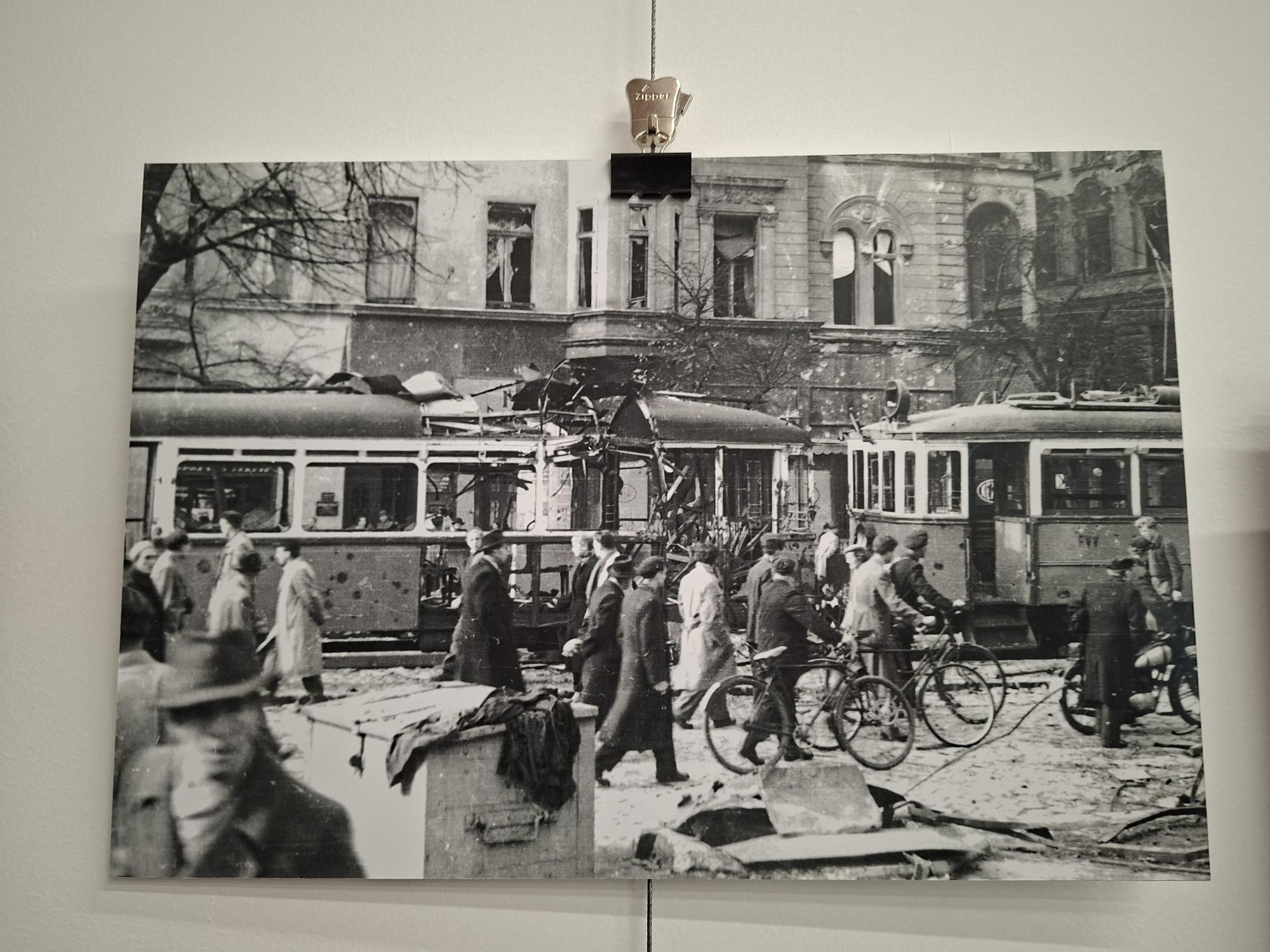
Along with such declarations and flyers, the photos in that exhibition bear witness to what ordinary citizens thought important to memorize through the medium of photography. It is indicative that a lot of the photos that people took were of the destruction inflicted upon the public transport by Soviet military forces. Public transportation in the popular imaginary is often perceived as the veins of urban life. Here are two characteristic examples:
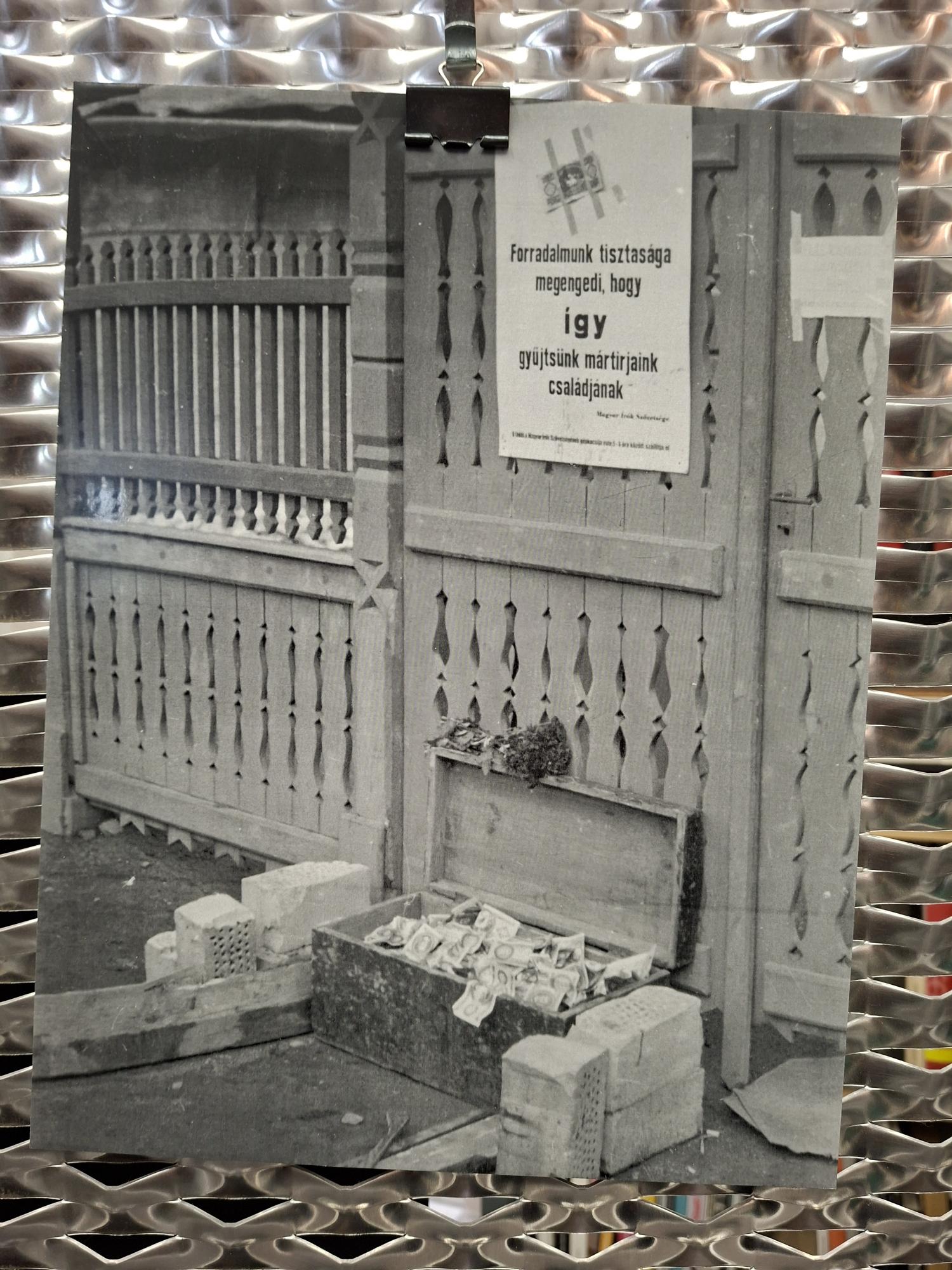
Another thing was the high level of solidarity exhibited between people during the days of the uprising. As the city of Budapest was under siege by Soviet military forces, there were increasing shortages of all sort. Contrary to the state propaganda that painted the people as “looting vandals”, amateur photographers have captured unguarded fundraising boxes that were open for the public to donate for various causes. This initiative was undertaken by visual artists Miklos Erdely and Tibor Gayor to both help the resilience of the community and showcase that people genuinely cared for their city. Here is a characteristic photo:
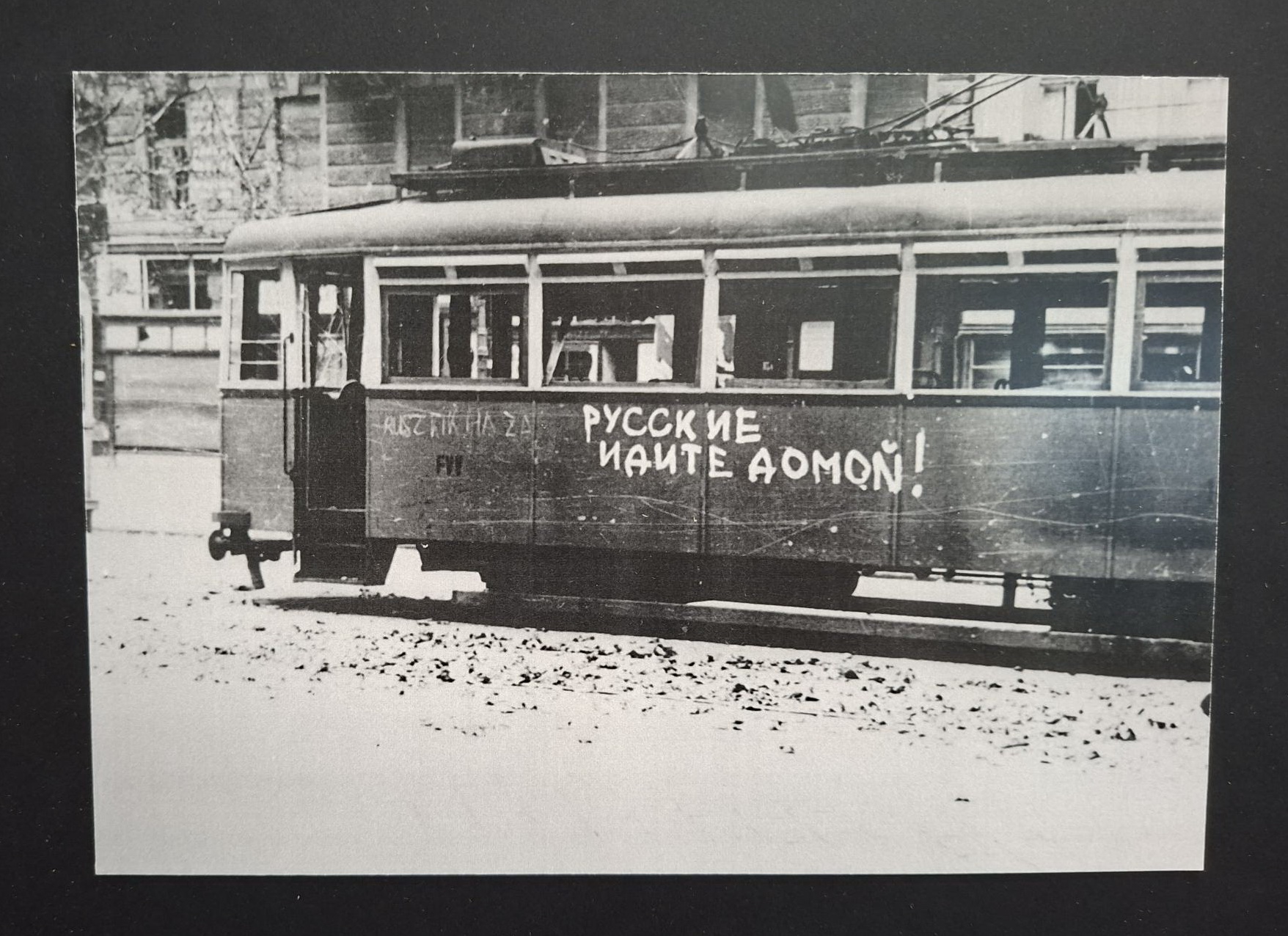
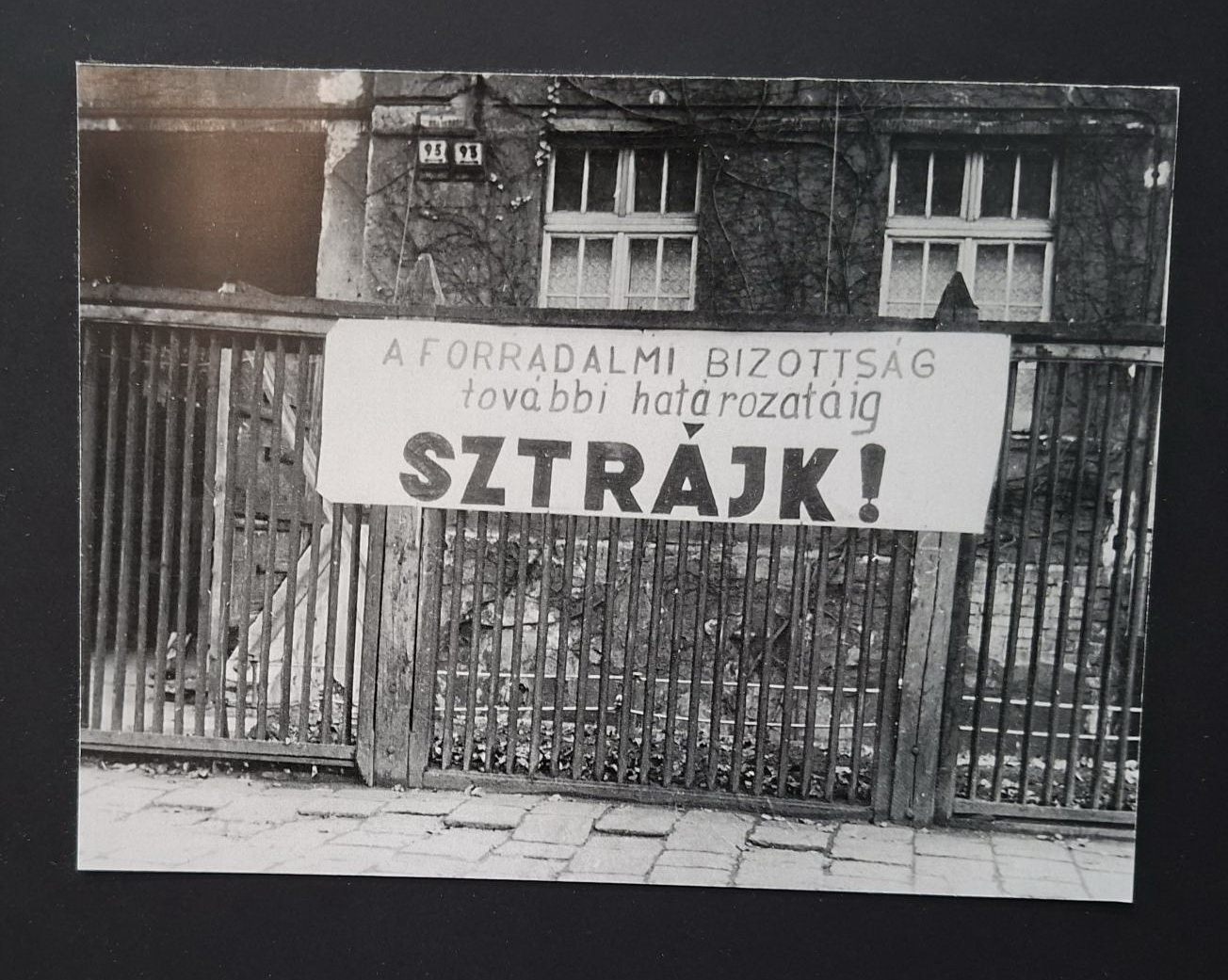
Throughout the uprising the slogans also changed. In the beginning the main slogan that could be seen on walls, destroyed public transport and military equipment was intended toward the invading Russian soldiers: “Go Home!”. Later on, with the suppression of the uprising, the message shifted to “Strike!”, with people and workers’ councils placing their hope in their ability to paralize the city with an all-out strike.
Another important thing that amateur photos reveal is that ordinary people avoided taking photos of their fellow neighbors who have taken up arms. This stands in stark contrast with international news agencies that sought to document armed citizens in the name of sensationalism. This distinction is significant as such photos were later used by State authorities in trails and persecutions against people who took part in the uprising, resulting in hundreds of executions. This shows that common toilers were conscious of the dangers that faced them and took care of each other.
Ultimately, the 1956 Budapest uprising was a pivotal moment for the autonomous tradition as it saw a burst of democratic creativity and popular solidarity in the name of freedom. It was suppressed with severe brutality, as most such historic experiences face from the forces of domination. But it left a powerful legacy of the potential of the grassroots to take matter in their own hands and initiate change, leaving inspirational mark for the generations to come.