by Alexandros Schismenos
Are we justified in judging Nolan’s “Odyssey” in terms of the fidelity of its adaptation, as if it were a literary analysis, or in terms of historical accuracy, as if it were a documentary rather than a work of fiction? That would be like judging *Interstellar* in terms of theoretical cosmology.
On the other hand, can we separate Nolan’s “Odyssey” from the historical context of the metaphors and reinterpretations of the Homeric “Odyssey” throughout the centuries, as if it were not a conscious artistic interpretation? That would be like erasing the entire tradition that begins with Homer, a tradition to which Nolan also belongs and from which the “Inception” of the new film springs.
We cannot view Nolan’s “Odyssey” outside the cool shadow of Homer, and Nolan is certainly aware of this. For this is essentially the gamble and the risk for anyone who adapts the Odyssey as a creator, the gamble and the risk of exposing oneself to the endless accusations of Homer scholars or of being permanently ridiculed. The latter befell Kazantzakis, who, in his boundless arrogance, aspired to write the “sequel” to the Odyssey in 33,333 Cretan-style verses, a round number that led Renos Apostolidis to rightly wonder whether the Cretan author had added or subtracted verses to achieve it exactly. Nolan avoided this pitfall, as the film—if not a masterpiece—is nonetheless a consummate cinematic achievement that, in fact, eschewed easy technological solutions by inventing new techniques.
However, he did not avoid the latter, the justified criticisms of Homer scholars, foremost among them Emily Wilson, who described the film as “a combination of grandeur and superficiality” that oversimplifies the Homeric heroes.
She claimed that Nolan’s narrative is contradictory:
“In comparison with other blockbusters—such as, say, the Die Hard films, also action-packed tales of one man’s dangerous journey back to his wife—The Odyssey contains far more pontificating about values and civilizational decline, but much less coherence and less heart. It gestures at a critique of xenophobia and violence, but it focuses primarily on the perspective of the guilty, traumatized warrior rather than that of his victims. Moreover, the movie’s devoted attention to mechanics, and its heedless willingness to give us massacres as spectacle, undermines its moralizing claims of caring about man’s inhumanity to man. Verbally, we are told that people matter; visually, we are shown that they do not.”
In any case, Nolan succeeded in creating a work that caused a sensation and sparked a storm of public debate for reasons entirely unrelated to the aesthetic evaluation and artistic criticism of a cinematic work. Similarly, I will not address the content, the aesthetics, or the messages of the film in and of itself, but rather comment on the assumptions underlying the broader public discourse surrounding the comparison between the film adaptation and the literary original, as well as with some of our latent and misguided expectations regarding the Homeric work, which are directly linked to broader current concerns regarding technology and sovereignty. Vasilis Lampropoulos, a professor of Greek Literature at the University of Michigan, has quite rightly observed that “criticism that examines new art practices draws on cultural studies to comment on phenomena and events,” while in a Facebook post on July 20, 2026, regarding Nolan’s film, he pointed out:
“…the cultural wars being waged internationally these days (triggered by Christopher Nolan’s film) surrounding the supposed author/Homer and the work/‘”Odyssey” correspond to the debates among Greek critics regarding the role of the writer and the nature of the literary work. Those who argue that literary criticism must remain faithful to the original and that interpretation must serve the authentic work are acting just like those who insist that Nolan’s “Odyssey” should remain faithful to the Homeric epic”.
Thus, a web of opinions, disagreements, and debates has emerged in response to Nolan’s film, addressing issues of reception, understanding, and—above all—appropriation and exploitation of the Homeric texts that go far beyond the film itself, without, however, abandoning them as the criterion for comparison.
This makes it a cultural phenomenon rather than an autonomous artistic work and, externally, a possibility that is nonetheless grounded in its intrinsic dependence—as an adaptation—on the original Homeric work. It appears that derivative artistic creations, particularly adaptations of classical works of the “Western Canon,” hold particular symbolic power in the realm of contemporary cultural discourse.
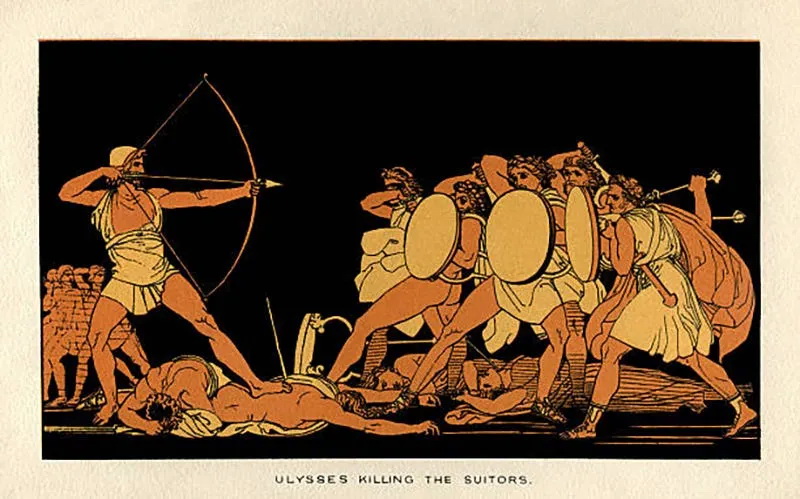
When the global advertising campaign and advance ticket sales for Christopher Nolan’s film *The Odyssey* began, public discourse focused obsessively on the film’s casting, specifically on the decision to cast the beautiful African-American actress Lupita Nyong’o in the roles of Helen of Troy—as well as Clytemnestra. The controversy that ensued was both intense enough to overshadow any further discussion of other aspects of the production and so widespread that it swept across all social media platforms, providing free publicity for the film. Readers of Homer knew full well that Helen’s role in the “Odyssey” is minimal and almost purely decorative, and viewers of the film realized that all this verbiage about the “woke agenda” and Homer’s “misappropriations” was simply a marketing ploy on Nolan’s part, as it served no greater purpose—neither in terms of minority representation nor from a narrative standpoint.
After all, Homer considered the black Ethiopians to be the most beautiful among mortals and the closest to the gods:
“Yesterday, Zeus went off to Ocean, joining
the noble Ethiopians [ἀμύμονας Αἰθιοπῆας [ἀμύμων: noble, excellent, honorable]
for a feast.
The gods all went with him.” (Iiad, A 422-424, trans. E. Wilson)
But Nolan is, of course, neither the first nor the last to use the figure of Helen for promotional purposes. The first is probably more famous than Nolan and belonged to the classical period.
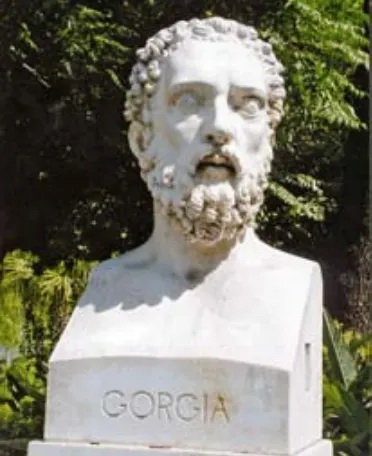
Gorgias of Leontini visited Athens in 427 B.C. during the Peloponnesian War as a member of the Leontine delegation to the Athenian assembly to request assistance against the attacks by the Syracusans. Gorgias, seeking to impress the Athenians with his unparalleled rhetorical skill, delivered his famous “Encomium of Helen” in which he provocatively defended the Homeric Helen against the established stereotypical slander portraying her as an unfaithful, cunning, and self-centered woman.
Gorgias’ speech was provocative to the Athenians of that time and remains striking even to us today, as it constitutes irrefutable evidence of an explicit challenge to established tradition —in our case, the undisputed Homeric authority, which formed the basis of classical education—in terms of philosophical criticism, that is, with the demand to scrutinize reasoning using its own means:
“For if all persons on all subjects had both memory of things past and awareness of things present and foreknowledge of the future, speech would not be similarly similar, since as things are now it is not easy for them to recall the past nor to consider the present nor to predict the future. So that on most subjects most men take opinion as counselor to their soul, but since opinion is slippery and insecure it casts those employing it into slippery and insecure successes.” [Encomium of Helen, par. 11]
Since, then, human reasoning is based on glory and faith rather than on certain historical knowledge—which would presuppose chronological omniscience, that is, direct perception of both the past and the future, the transcendent timelessness of consciousness, then they rest on uncertain and shaky ground, which allows us to shift their apparent meaning by revealing their latent significance.
Gorgias adopts a different perspective on the myth of Helen and thus reverses the interpretation of her actions and the assessment of her character, without questioning the mythological framework of metaphysical predetermination:
“For either by will of Fate and decision of the gods and vote of Necessity did she do what she did, or by force reduced or by words seduced or by love possessed.Now if through the first, it is right for the responsible one to be held responsible; for god’s predetermination cannot be hindered by human premeditation.” [Encomium of Helen, par. 6]
Gorgias achieved his goals in Athens, as the city formed an alliance with the Leontines, and he himself began a brilliant career teaching rhetoric that shaped the intellectual landscape of the classical era.
Echoes of his eulogy can be found in Euripides’ “Helen”, which was performed at the Great Dionysia fifteen years later, in 412 B.C., following the destruction of the Athenian fleet during the hubristic Sicilian Expedition, which was, in a sense, the tragic culmination of the conflict with the Syracusans that began with Gorgias’s visit.
Euripides concludes the play with words of praise for the heroine, while the Chorus anticipates the audience’s surprise at the unexpected subversion of our expectations:
“Theoklymenos:
Let Helen go home [oikos], if the gods think it right.
Know that you are born from the same blood as a sister
who is the best [aristē] and also most wise [sōphrōn];
may you fare well,
for the sake of Helen’s most well-bred mind, a
quality not to be found in many women.
Chorus:
Many are the forms of divinities,
and many things the gods bring to pass unhoped for.
And what was expected has not reached a purpose [telos];
for what was not expected, a god finds a way.
Such was the result of this action.” [Helen 1684 – 1692, translation by E. P. Coleridge]
Could one perhaps venture the bold hypothesis that the mythical Helen also indirectly provoked a second war, this time historical rather than mythological? By no means, although on a symbolic level the power of Helen’s figure as the embodiment of the vanity of war rhetoric and the deceptive illusion of glorious violence was intense in the social imagination of the Greek city-state.
But here begins another thread of anachronistic expectations and interpretations.
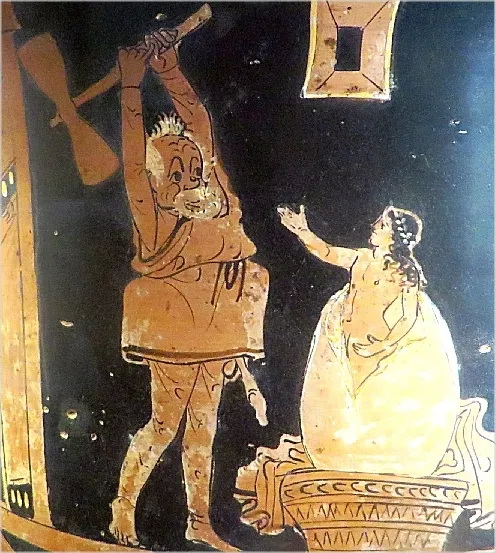
Is Homer, after all, a historian? Does he present us with depictions of the Mycenaean society in his epics, as other critics of the film have claimed, focusing on the accuracy of the weapons and clothing compared to archaeological Mycenaean finds? Of course, such claims are ridiculous.
The differences between the Homeric world and the Mycenaean world outweigh the similarities. As M.I. Finley convincingly demonstrates, in the Homeric world there is neither a palatial bureaucracy nor centralized authority of the Mycenaean type. Furthermore, there is no knowledge of the military use of chariots—the preeminent military weapon of the Bronze Age—with the result that in the *Iliad*, chariots are used merely to transport the heroes to the battlefield. Even more importantly, in the Homeric epics there is no example of written language or any evidence of writing, as messages are conveyed orally or through symbolic signals such as beacons. In contrast, Mycenaean civilization was a literate civilization—even though the ability to write remained the privilege of the upper elite—characterized by the continuous recording of activities in temporary records on clay tablets. The administrative use of writing is a widespread feature of all organized societies of the Bronze Age—the Egyptians, the Minoans, the Mycenaeans, the Hittites, etc. [M.I. Finley, The World of Odysseus]
In the Homeric world, the absence of writing is an indication of the traditional cosmic semiotics that transforms the entire firmament into a vast book of symbols that those with the proper knowledge—seers and sages—can decipher. In this magical universe, teeming with signs— —which responds to human calls, albeit in enigmatic ways, the presence of human writing seems superfluous, and the human voice suffices. Homer, the first writer, presents us with a fully oral culture, one that, however, never historically existed, since writing was an essential prerequisite and condition for the existence of the organized societies inhabited by his heroes.
For the ancient Greeks, moreover, the Trojan War was the event that bridged the misty realms of myth with the sunlit valleys of history—not the fall of Mycenaean civilization, which they did not recognize as a distinct civilization. In the mythical imagination, there is no cultural succession but rather ontological succession, and Homer’s world is the world of heroes lost in the mists of myth.
In the ancient Greek imagination, a hero is not a superhuman or infallible being, but a mortal who enjoys a privileged, direct, and personal connection with the gods. The hero worship that flourished throughout the Greek-speaking world during the Geometric period, when the Homeric epics were composed, served as a way to keep open the channel of communication between the human community and the gods—a channel embodied by the hero. Nothing guaranteed that this privileged communication between the hero and his gods would ensure his happiness, as all the heroes of tragedy demonstrate. The superhuman hero is a modern and anti-mythical construct.
But historical consciousness and research signify a break with the authority of mythological narrative. Indeed, by reading Herodotus, see how the emergence of historical consciousness and historical research stems precisely from the questioning of mythical narratives about the causes of wars—and specifically from the questioning of Helen as the cause of the fall of Troy.
“These Asians,” say the Persians, “when their women were abducted, did not take it seriously, whereas the Greeks, for the sake of a Spartan woman, launched an entire campaign, came to Asia, and destroyed the power of Priam. […] But I have not come to speak of these things—whether they happened this way or that—but of the one whom I myself know to be the first to have committed unjust acts against the Greeks; I will present him first and then continue my story, pausing here and there in the small and large cities of men.” [Histories book 1, Cleo, 1.5.1.]
Consequently, Homeric literature and research concerning the Trojan War are also ancient. In fact, we have two historical events that demonstrate the fundamental importance of the Homeric epics as a political—rather than a metaphysical—origin myth for the historical self-understanding and collective identity of the ancient Greek cities, that is, for the construction of their social imaginary time over the long span of historical narrative.
The first fact is the existence, in historical times, of a group of rhapsodes from Chios—one of the places claiming Homer’s origin—who were entrusted with the preservation and transmission of the Homeric epics orally, through recitation. At some point, they gained exclusive rights to this privilege—the public recitation of the Homeric epics—and we can imagine that this conferred enviable prestige and cultural influence. The famous “Homeric Hymns” to the gods were likely composed by these official Homeric reciters of antiquity.
The second event is the definitive publication of the Homeric epics by the Athenian tyrant Peisistratus during the second half of the 6th century B.C., a move that was, on the one hand, decisive for the subsequent preservation and faithful transcription of this edition, which has remained virtually unchanged to this day, but, on the other hand, was likely a politically calculated move aimed at enhancing Athens’ propaganda image through specific interventions, which remain a mystery to us. We do know, however, that the Megarians accused Peisistratus of inserting a forged verse into the Iliad to portray the Athenians as having participated in the campaign alongside the Salaminian forces and to provide a Homeric justification for the violent incorporation of Salamis into the Athenian city.
Specifically, the second line of couplet 557–8 in Iliad B was considered by the Megarians to be a forgery:
“And Ajax led twelve ships from Salamis,
and stationed them beside the lines from Athens.” [Iliad, B 557-8, trans. E. Wilson]
Although Alexandrian scholars of the Hellenistic period supported the Megarian position, for us the question is not who was right, but how the Homeric texts were used as tools of poetic justification for political purposes as early as the dawn of the Classical era. And, as we saw in Nolan’s film, this continues to this day.
There is, of course, a huge difference between Nolan and Homer—first and foremost a socio-historical one—since the latter is a timeless and cross-cultural symbol of poetic genius, in a way that no contemporary person can hope to match; indeed, he even represents a starting point, since his works are taken as a given in the entirety of European literature tradition.
This unique position of Homer as both the pinnacle and the origin is a common theme in the Greek and Roman imagination of antiquity.
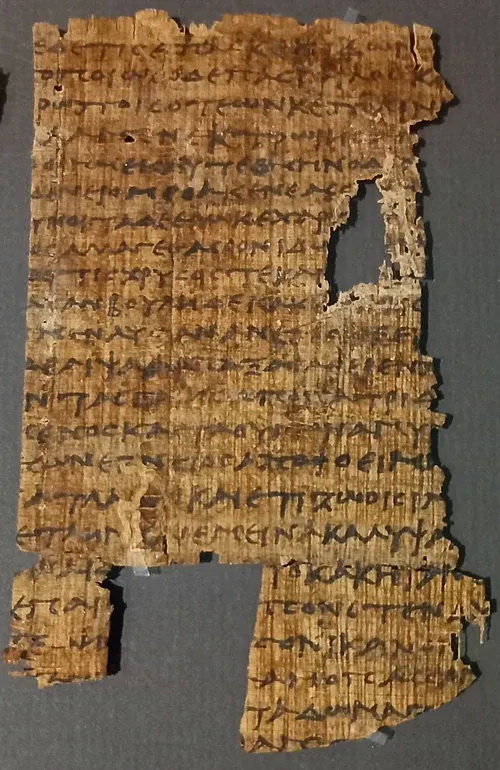
The most reliable source for works of antiquity is Egypt, where papyri are preserved due to the climate. Thus, among the papyri discovered in Egypt, fragments from approximately 3,000 copies by identified authors have survived. If we compare the surviving texts, we have an imperfect but at least clear indicator of the authors’ popularity in late antiquity, which may give us a sense of Homer’s enduring appeal. So here is the list:
First is Homer, who surpasses all other authors combined, with 1,680 individual copies of the “Iliad” and the “Odyssey”m more than half of the total.
Second is Demosthenes, the most popular prose writer, with 204 identified copies of his speeches.
Third is Euripides, the most popular tragedian, with 169 identified copies, some of which are works that have not survived in their entirety, such as the tragedy “The Cretans” and the satyr play “Cyclops’.
Fourth is Hesiod, of whom 137 copies have been identified from the “Theogony” and the “Works and Days”.
Fifth is Isocrates, of whom 132 copies of his works have been identified.
Sixth is Menander, the preeminent comic playwright, surpassing Aristophanes, with 105 identified copies.
Seventh is Plato, the most popular philosopher, with 103 identified copies, not counting the disputed ones.
Eighth is Thucydides, the foremost historian, with 98 identified copies. Ninth is Aristophanes, with 59 copies.
Tenth is Herodotus, with 48 copies. Eleventh is Sophocles, with 37 copies. Twelfth is Aeschylus, with 33 copies.
Thirteenth is Hippocrates, the most popular physician, with 29 copies.
Fourteenth is Sappho, the “female Homer,” with 25 copies.
Certainly, Homer’s central place in the historical imagination of Euro-Western civilization has not
diminished; on the contrary, it has been reinforced in modernity through the “imposition” of Homeric authority on all European societies.
Hegel noted in his school diary in 1787 that he could not stop reading *Sophies Reise von Memel nach Sachsen* (*Sophie’s Journey from Memel to Saxony*), a popular romance novel with no literary pretensions. This prompted the envious Arthur Schopenhauer to declare: “My favorite reading is Homer, while Hegel’s is Sophie’s Journey.”
Moreover, Homer’s ability to create brilliant poetic images and similes remains unparalleled, observing detail and crafting metaphors with ontological clarity, without overlooking the value of the small in relation to the great, even extolling the courage of a fly in a way that would surely have pleased Schopenhauer.
“She made his arms and legs more powerful,
and set in him the courage of a fly,
who works so hard and so persistently,
yearning to bite a human being’s flesh
because she loves the taste of human blood.
This was the boldness that the goddess put
inside the inmost heart of Menelaus,” [Iliad, R 727-731, trans. E, Wilson[
And, within a more recent yet broader socio-historical context, we can recall the poem “Homer” by Derek Walcott from the Caribbean island of Saint Lucia, which transposes Homeric motifs to the Caribbean, presenting the epic as the quarrels and wanderings of local fishermen, and which won the Nobel Prize in Literature in 1992.
Or we can recall Bob Dylan’s lecture upon receiving the Nobel Prize in Literature in 2016, in which he took care to grasp the ontological and existential thread connecting the Homeric Odysseus with modern man, clearly answering the underlying question that arises with every reference to Homer: Why does he still matter to us after 2,700 years?
“The Odyssey is a strange, adventurous tale of a grown man trying to get home after fighting in a war. He’s on that long journey home, and it’s filled with traps and pitfalls. [….] In a lot of ways, some of these same things have happened to you. You too have had drugs dropped into your wine. You too have shared a bed with the wrong woman. You too have been spellbound by magical voices, sweet voices with strange melodies. You too have come so far and have been so far blown back. And you’ve had close calls as well. You have angered people you should not have. And you too have rambled this country all around. And you’ve also felt that ill wind, the one that blows you no good. And that’s still not all of it.”
Dylan then, upon concluding his speech, grasped the invisible and unbreakable thread of poetry, recognizing Homer as a bardic ancestor and invoking Homeric verses as an embodiment of oral memory:
“I return once again to Homer, who says, “Sing in me, oh Muse, and through me tell the story.”“
Dylan views Homer as a songwriter, projecting his own horizon of expectations onto the timeless interpretive horizon.
However, someone else, such as M. I. Finley, might argue that Homer represents precisely a break with the tradition of the bards—the rhapsodes who, as wandering poets, preserved the myths of tradition through the spoken word— because Homer writes, and thus records and preserves his words verbatim.
He is the first author, the emphatic emergence of poetic written language using the alphabet, which has the paradoxical distinction of being both the first and the supreme expression of poetic imagination in written form. This Homeric turning point marks the emergence of the first universally literate society in history—a world-historical event that fosters the democratic and philosophical explicit questioning of tradition and, ultimately, of Homer himself.
We can listen to the songwriter Dylan to stop harping on director Nolan about the liberties he took in his cinematic adaptation of the Odyssey, often at the expense of the meaning and characterizations of the Homeric text.

After all, Nolan did not bring the Homeric Odyssey to the screen, but rather his own interpretation of the Odyssey myth, shaped by contemporary anxieties and contradictions and drawing on diverse and varied historical reinterpretations of the myth.
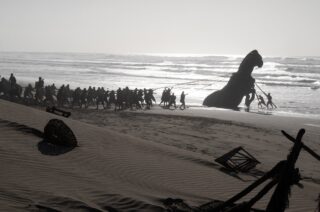
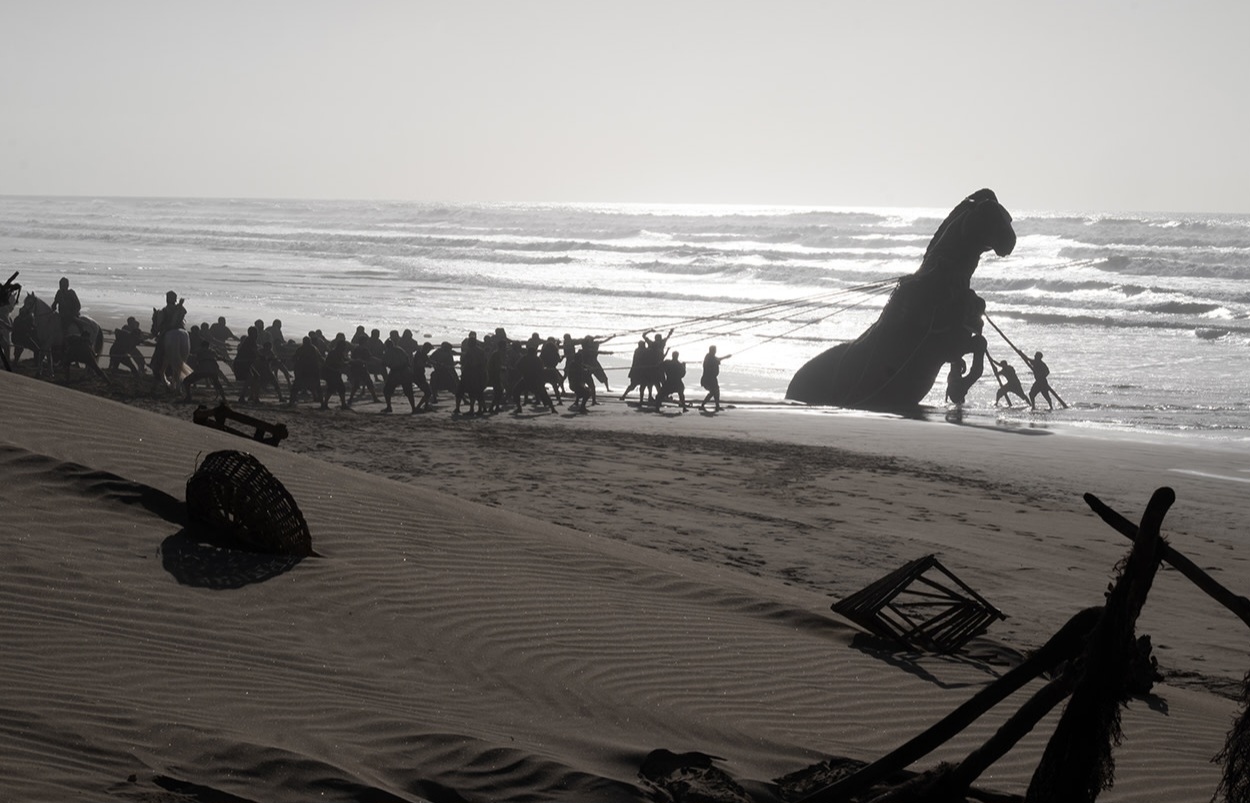
Nolan’s Odyssey is inspired by Virgil’s Aeneid, which is why Odysseus is portrayed as a repentant conqueror tormented by guilt over Troy, rather than as a resourceful and perceptive wanderer —he follows the Latin poet, who adopts the perspective of the Trojans as “ ,” whom he imagines as the ancestors of the Romans. All the scenes involving the Trojan Horse, as well as Sinon, are found in the *Aeneid*, but not in the “Odyssey” nor, of course, in the *Iliad*. Unless, of course, Nolan was inspired by the few fragments of the “Little Iliad,” a minor work by a disputed author that has been lost.
It is clearly a mistake to compare Homer with Nolan, not only because there is no valid historical analogy, but also because they work in different art forms. As early as the 4th century B.C., Aristotle pointed out how different the narrative techniques and performance requirements of epic poetry and drama are, comparing Homer to the tragedians:
“Homer, however, who excels in every other respect, seems to have grasped this correctly as well, whether because of his art or his natural talent: In composing the “Odyssey”, he did not include in his poem everything that happened to Odysseus […] In an epic poem, due to its length, the parts take on a proportionate scale; in dramas, however, such a scale leads to a result quite contrary to what is expected. (Poetics 1451a & 1456a)”
Nolan serves a contemporary art form which, although it borrows the plot and the actors, is not drama. Cinema possesses its own aesthetics, its own relationship to technique, its own vectors of representation and transformation of representation, its own illusory movement, and its own temporality.
But in this way, it is closer to the oral dimension of the epic as recitation, since a film has the same temporal structure of sequential unfolding—through the disappearance of the earlier in favor of the later—as a melody.
As B. Stiengler notes, the principle of cinema is to link different elements together into a unified temporal flow that resembles the subjective, imaginative flow of consciousness.
“And if it were possible to demonstrate that lived reality is always a construct of the imagination and thus perceived only on condition of being fictional, irreducibly haunted by phantasms, then we would finally be forced to conclude that perception is subordinated to—is in a transductive relationship with—the imagination; that is, there would be no perception outside imagination, and vice versa, perception then being the imagination’s projection screen. The relationship between the two would be constituted of previously nonexistent terms, and this in turn would mean that life is always cinema and that this is why “when one loves life one goes to the cinema,” (B. Stiegler, *Technics and Time*, vol. 3, p. 14)
For the French philosopher, the uniqueness of cinema lies in this ability to create a temporal narrative flow grounded in the immediate imaginative reception of images whose speed of sequential juxtaposition exceeds the capacity of visual perception to discern their boundaries, in such a way that cinema comes closer to the inner sense of temporality. For indeed, the imagination—not in its subjective, individual expression, but in the manifestations of the objectification of meanings and symbols by the social imagination— the imaginative capacity for symbolic representation and the linguistic self-creation of socially validated meaning constitutes the intersubjective fabric of social time; we could say that cinema is a mechanism of technological re-interpretation of the dominant patterns of the social-historical field.
That is, it is par excellence a machine for creating imaginary realities through visualization and visual representation at a given pace of unfolding. When we watch a movie in the theater, we are swept up in its rhythm; we do not impose our own temporality but submit to the work’s self-contained temporality, in our imagination we endure and traverse the intervals of time alongside the characters on the screen, even though physically we remain within the universal duration of natural time. Behold the magic of cinema, which makes it possible for the imagination to move while the body remains motionless, to experience speed, suspense, and rhythm while the viewer remains static, glued to their seat, immersed in the totality of the visual field clearly framed by what lies outside the screen.
Nevertheless, the viewer’s imagination, just like the gaze, is so deeply immersed within the screen that the world presented there temporarily takes the place of reality, so that the visible boundary becomes imperceptible and the latent boundlessness of cinematic representation creates the illusion of the infinite. In this sense, cinema shares something in common with the recitation of an epic and the performance of a drama, namely the immobilization of the audience through the mobilization of their imagination in a manner controlled by the creator but unfolding in the manner of temporality, that is, sequentially and never as a whole.
“A film, like a melody, is essentially a flux: it consists of its unity in and as flow. The temporal object, as flux, coincides with the stream of consciousness of which it is the object: the spectator’s. The power of these two cinematic principles, and thus of the singularity of cinematic recording techniques, results from two other co-incident conjunctions: —on one hand, the phono-photographic coincidence of past and reality (“there is a double conjoint position: of reality and of the past,” which induces this “reality effect”—believability—in which the spectator is located, in advance, by the technique itself); —on the other, the coincidence between the film’s flow and that of the film spectator’s consciousness, linked by phonographic flux, initiates the mechanics of a complete adoption of the film’s time with that of the spectator’s consciousness—which, since it is itself a flux, is captured and “channeled” by the flow of images.” (Stiegler)
However, the technological connotations and possibilities of cinema are radically different from those of the traditional arts, which rely primarily on the human body as an instrument of expression. For cinema, the human body is a symbol among symbols—not necessary, but useful. In terms of cinematic technique, the human body is presupposed in production and reception as the eye behind the camera and the gaze facing the screen, outside of the film’s frame. The technique of cinema consists of photographic mechanical recording, phonographic mechanical reproduction, and editing—the cutting and splicing of disparate images—while the continuity and unity of the human body form the technical foundation of the other arts.
I have termed “cinematic nostalgia” the nostalgia for things that the subject has not experienced but has been shown. What distinguishes this type of nostalgia is that, on the one hand, it manifests as strictly individual and often clashes with or even contradicts the individual’s immediate social environment, (as is often the case with individual nostalgia, e.g., that of a person in love), but on the other hand, it necessarily has a collective reference and is projected as essential to society (as is usually the case with collective nostalgia, e.g., that of an exiled minority).
We have noted previously that the individual and the collective are interconnected, but in the case of cinematic nostalgia, this connection appears to be direct and necessary; above all, the object of its desire is entirely representational and not at all institutional, completely unattainable and entirely utopian. The object of cinematic nostalgia’s desire must be unattainable and unrealizable, because only then can it be maintained as a pure representation, while simultaneously preserving its exclusive individuality and its imaginary universality.
As such, it can easily be mass-produced and become a product of the cultural industry.
And I believe that the cinematic nostalgia of Nolan’s “Odyssey” is not the Homeric nostalgia, whose primary meaning is different. It signifies the pain caused by distance from the familiar, from one’s birthplace, from one’s imagined homeland, as well as the pain caused by the intense psychological pull that this place exerts from afar. The imaginary birthplace, the psychological home, whatever form it may take (because, as an imaginary construct, it need not even exist in the conventional sense), functions as a repressed desire and creates an unconscious realm of repressed desires, which determine not only the fundamental structure of the conscious self’s identity but also the outlook and unconscious tendencies of the individual who feels nostalgia.
Thus, filmmaker Nolan cannot remain faithful to the Homeric original, which he must edit—that is, deconstruct, evaluate, and reconstruct—into his own interpretive proposal that is neither analyzed nor explained but is simply presented and signifies. Since the film is grounded in the original epic, what matters is not only what the director chooses to show, but also what he chooses not to show, as the final film is precisely the aesthetic result in which the aesthetic criteria of that selection are implicitly inscribed.
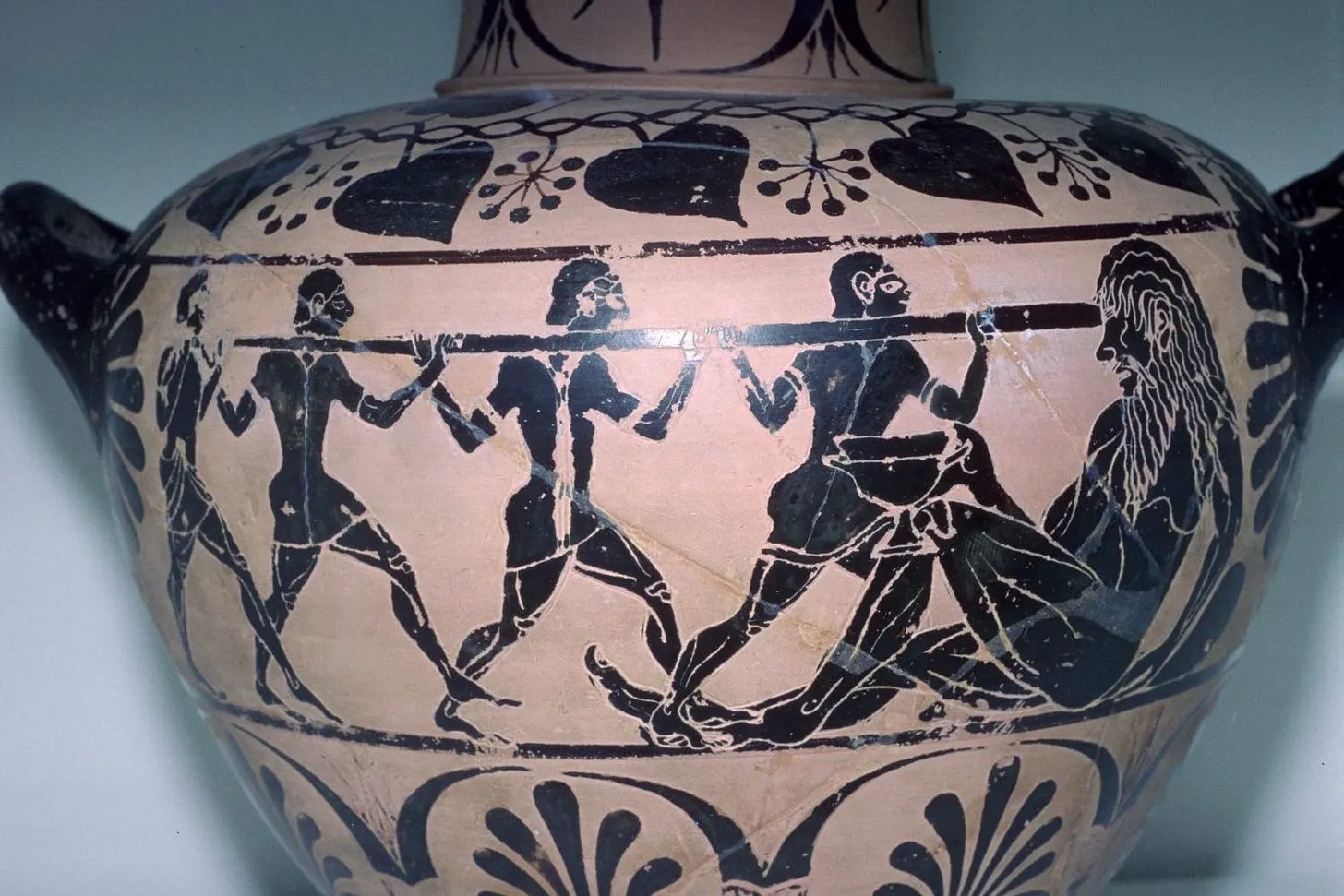
Nolan, first of all, chose to omit Odysseus’s dialogue with the Cyclops, in which the hero identifies himself as “Nobody” only to then taunt the beast by revealing his name, essentially committing the arrogant hubris that will provoke Poseidon’s wrath—a hubris of self-affirmation by the subject against the forces of nature. But, since Odysseus will eventually reach Ithaca, might the Odyssey itself be an act of self-affirmation by the human subject in the face of impersonal forces? How significant is this episode that Nolan omitted?
According to Liddell & Scott’s Lexicon, the name Ὀδυσσεύς derives from the ancient verb ὀδύσσομαι, which means “to be enraged against someone, to get angry.”
James Joyce, on the other hand, claimed that the name Odysseus comes from Oὖτις (Nobody) and Zeus (God), which is why he gave it to Leopold Bloom.
Of course, Joyce was speaking from his imagination, without any evidence. But this gives us a clue as to what Joyce was thinking about Odysseus when he wrote his monumental novel “Ulysses”, which defied every literary convention, drawing on every literary and non-literary narrative technique, transposing cinematic montage into internal monologue and the interplay of social temporality with natural time into the nightmare of History.
Joyce knew as much about cinema as he did about the “Odyssey”. On December 20, 1909, Ireland’s first movie theater, the Volta Cinema in Dublin, opened. Its conception, implementation, and management were the work of 27-year-old James Joyce. The first screening featured the Italian film *Beatrice Cenci* (1909) by Mario Caserini and the documentary *Concorso di bellezza fra bambini. Une Pouponnière à Paris*, dedicated to Maria Montessori.
However, Joyce’s reputation as an atheist had spread. “Are you Catholic? You can’t come in,” said the malicious, patriotic voices. Thus, the only movie theater in Ireland closed in July 1910. Twelve years later, in 1922, Dublin had thirty-seven new movie theaters. Joyce had “Ulysses”.
Joyce was a writer, like Homer, and although a writer does not impose the pace of reading on the reader, he uses the same narrative flexibility to create the rhythm of the plot, which he controls intrinsically. Some have spoken of the nonlinear unfolding of Nolan’s film as a hallmark of his directorial vision, but they seemed to overlook the fact that Homer himself bypasses linear narration to begin the epic in media res, in the midst of the action. Homer, both the beginning and the pinnacle, seems to encompass the entire spectrum of narrative techniques.
Secondly, Nolan chose to omit Scheria, the island of the Phaeacians. And here we have an emblematic location in the Homeric text of paramount importance. For here, in the Homeric text, we have the quintessential first-person narration of the Odyssey—which, let us not forget, is the narrative of Odysseus himself. Everything mythical and supernatural that happened to Odysseus is attested to by Odysseus himself, and no one else. What if we consider Odysseus an unreliable narrator, consistent with the cunning and selfish Odysseus presented to us by Sophocles and Euripides? It is up to the listener or reader to decide whether to accept Odysseus’s account as plausible and sincere or as mere delusion resulting from post-traumatic shock. Nolan, who seems to choose the latter in order to build Odysseus’s entire persona upon it, does not make use of Homer’s cunning device of having the hero recount the marvels to us, while the poet’s voice, guided by the Muse, narrates the events in the “real” world of Ithaca, Sparta, and Pylos—with the exception, of course, of the gods’ discussions.
The Phaeacians certainly accept Odysseus’s account as absolutely true, but the Phaeacians themselves are a mythical people, straddling the line between mortality and divinity, who escaped barbarism by migrating from a land neighboring the Cyclopes and achieved what may be the first utopian society in the Western imagination.
By omitting the Phaeacians, Nolan also misses an opportunity to align the Homeric narrative with our current anxieties about the dominance of Artificial Intelligence, since in the original text Homer seems to describe the Phaeacians’ ships as sailing autonomously, as if some intelligent software were guiding them:
“Phaeacians have no need of men at helm
nor rudders, as in other ships. Our boats
intuit what is in the minds of men,
and know all human towns and fertile fields.
They rush at full tilt right across the gulf
of salty sea, concealed in mist and clouds.
They have no fear of damages or loss.” [Odyssey, 8, 556-562, ttans. E. WIlson]
Did Homer, then, foresee Artificial Intelligence? Certainly not, unless we commit the error of anachronistically projecting our own predictions onto the earliest literary text of our tradition. If we do fall into such an error, we can take comfort in the fact that the text continues with a warning:
“But once I heard Nausithous, my father,
say that Poseidon hates us for the help
we give to take our guests across the sea,
and that one day a ship of ours would suffer
shipwreck on its return; a mighty mountain
would block our town from sight. So Father said.”
This warning is prophetic, since Poseidon actually petrifies the Phaecian ship that brings Odysseus to Ithaca, after her departure from the island.
“Hearing this, Poseidon
went to Phaeacian Scheria, and waited.
As the ship sped towards the shore, the god
moved near it, turned it all to stone, and slapped
his palm to make it rooted to the seabed.
He vanished, and the people of Phaeacia,
known for their oars and famous ships, began
to ask each other.” [Odyssey, 13, 160-165, trans. E. Wilson]
There are a couple of islets in the Ionian Sea, like Pontikonissi near Corfu, claimed as the petrified ship of the Phaecians.

But it so happens that Homer is the source of the imaginative horizons of the Euro-Western tradition in such a way that we can find the seeds of later and historically distant dominant social imaginative meanings, such as instrumental rationality, which Adorno and Horkheimer seek in Odysseus. Let it be noted in passing, without delving into the Dialectic of the Enlightenment, the thinkers of the Frankfurt School identify in Kanenos’s ruse in *Ulysses* the modern capacity for self-denial and instrumental reason that, in their view, makes Odysseus the archetype of the Western bourgeois subject. But this instrumental rationality has nothing to do with technology but rather with the pseudo-logic and ideology of the fictitious.
Homer does indeed describe automatons with human features, such as Hephaestus’s golden handmaids (korae chrysai—Iliad, S 418)—which remind us of robots, but it is a mistake to assume that they reminded the ancient Greeks of the same thing, since they had not been raised on fictional utopias or dystopias of robotic domination and algorithmic totalitarianism.
Just as stories of abductions by extraterrestrials bear structural and narrative similarities to Irish traditions of abductions by fairies, it makes sense that a culture with a vivid and anthropomorphic imagination, such as the Greeks—who imagined marble statues coming to life, as in the myth of Galatea and Pygmalion, and even had fetishes involving a passion for statues—it is therefore logical for such a culture to imagine bronze, iron, and gold statues coming to life. But the act of resurrecting inanimate matter is a divine act, not a human one; it is not a problem of mechanics but a miracle that appeals to transcendent faith. We have no depictions of robots on vases or elsewhere.
Similarly, it is futile to search for the locations of Odysseus’s journey on maps, whether modern or ancient.
There are thousands of interpretations and faces of Homer, as many as there have been interpreters of the two epics over the millennia, and the Homeric question—concerning the poet’s identity, whether he was one or two or many, the poet’s origin—over which seven cities vied in antiquity—the historicity of the episodes he describes, upon which modern archaeology was founded on the hills of western Turkey, in the plain of Argos, on Ithaca, Lefkada, and Kefalonia, and regarding the geography of Odysseus’s travels. These same issues, eternally enigmatic, have been raised once again in the wake of Nolan’s film.
I believe these questions are unsolvable, and therein lies the charm of the related discussions; they are free from the fear of being disproved because their hypotheses—regarding, for example, the historicity of Agamemnon—lie beyond the conditions of falsifiability.
For example, in the Hittite archives, specifically in the “Complaint of Mandubatta” (CTH 147), a text written around 1380 B.C., an Achaean [Ahhiyan] warlord named Attarsiya is mentioned, whom some have imaginatively identified with Atreus. However, both the interpretation and the meaning of the name, as understood by modern researchers, are largely predetermined—consciously or unconsciously—by the traditional meaning and the web of connotations, both ancient and modern, associated with the names “Atreus” and “Atreides,” which have settled like invisible sediments upon any contemporary research project. Consequently, the broader Homeric issue, like any interpretive question, remains open to reinterpretation.
Usually, the discussion of the “Odyssey” inevitably leads—if not exhausts itself—in the search for the actual geographical locations where Odysseus’s journey—mythical and fantastical at every level—took place.
We will avoid this barren rock with its delusional Sirens by following Eratosthenes’ advice.
“‘You will find the places where Odysseus wandered when you find the one who sewed the bag of the winds.’source: Strabo, Geography 1.2.15]
However, we must examine the significance of the mythical geography of the journey within the narrative context of the Homeric text and the semantic framework of the Homeric world.
This is a distinct field of research in Homeric studies, which we will merely touch upon. To begin with, the Odyssey is oriented toward the West, while the Iliad is oriented toward the East, as M. I. Finley insists. Some see in the *Iliad* collective memories of the first wave of Greek colonization and in the “Odyssey” collective memories of the second wave of Greek colonization.
What is certain, as far as the Odyssey is concerned, is that it presents the contrast between a real—potentially historical—world and a mythical—actively magical—world. Scheria, the island of the Phaeacians omitted by Nolan, is the sole bridge for returning from the superhuman world to the human world. The complete return to human society is marked by the Phaeacians laying the sleeping Odysseus at the roots of an olive tree in the “harbor of Phorcys” on Ithaca. The olive tree, which in Homer symbolizes the world of human society—as do grains, of the agrarian society of the household and the city, accompanies Odysseus on his wanderings as a reminder and a link to the society he seeks, for his rudder is made of olive wood, and the marital bed—which symbolizes his final return home—is also made of olive wood.
As Pierre Vidal-Naquet observes, Odysseus’s journeys are not geographical, but rather represent the extra-social and extra-human zone that surrounds the civilized human world of the cities.
“Crete, Egypt, and Epirus, on the other hand, possess a ‘reality’ that no one would dispute. For Odysseus, to leave this world means to leave a world that is not that of humans, a world that is successively superhuman and subhuman, a world where he will see, in Calypso’s palace, divinity, where, near Circe, he will risk descending into animality, but which he must abandon in order to return to normality.” [1983, p. 50]
Gods, humans, and animals are the three ontological levels of the ancient Greek imagination, the differentiation of which is determined, if we are to believe Aristotle, by the political element. The political element is defined by the tripartite articulation of the social space of the Archaic Greek city into the private (oikos), the semi-public (agora), and the public (demos). This differs from the structure of Mycenaean society, where the functions of both the semi-public (agora) and public (decision-making) spheres were absorbed by the centralized oikos of the anaktos (palace), which constituted an elite bureaucracy, and this social structure does not appear to have survived the fall of the palaces.
And Castoriadis correctly points out that Odysseus’s rejection of Calypso’s offer signifies a rejection of immortality, Odysseus’s conscious acceptance of the human fate of mortality, having first witnessed, during his descent into Hades, the shadowy fate of the dead, which the reigning Achilles considers inferior even to the most miserable life. This conscious acceptance of what it means to be human—of pain, but also of the warmth of human society symbolized by the hearth of the home—is the semantic core of Odysseus’s journey. And it is inextricably linked to the other novel social and imaginative meanings of the ancient Greek city-state—namely, the absence of religious revelation, and thus of divine command, since Homer is the foundation of the Olympian religion but his texts are literary rather than sacred; the ambivalence of the cosmic forces toward human suffering, and the impartiality that renders Hector morally superior to Achilles.
Nolan chooses to ignore these elements, presenting a different, fictional archetype: the Western colonizer who feels guilty about the violence that defines his social legacy—a man who never existed, because very few colonizers felt guilty, and very few guilt-ridden Westerners were colonizers. He reverses the mythical geography so that Odysseus is the invader, the technological force that destroys the mythical world around him. We thus lose Homer, to the benefit of Kipling, to whom we can respond by holding him accountable for his responsibilities.
But in this way, Nolan does not present the “Odyssey” as the self-definition of human historicity in the face of divinity and animality, nor a return to the socio-historical world after wandering through the mythical, but rather a narrative of false, ideological historicity that seeks to abolish itself. Thus, it is a contemporary, guilt-ridden, and cinematically nostalgic “Odyssey”, but not a Homeric one. But this is not a criticism of Nolan, since the very word “Homeric,” when not referring to Homer’s original work, signifies an attempt at imitation that risks being compared to the incomparable.
References
Gorgias, Encomium of Helen, in Rosamond Kent Sprague, ed. The Older Sophists: A Complete Translation by Several Hands of the Fragments in Die Fragmente Der Vorsokraticker Edited by Diels-Kranz with a New Edition of Antiphon and of Euthydemus. Columbia, South Carolina: University of South Carolina Press, 1972. 50-54.
Euripides, Helen, trans. Coleridge
Herodotus, Histories, Cleo
Homer, The Iliad, trans. E. Wilson
Homer, The Odyssey, trans. E. Wilson
Finley, M. I. (1982). The World of Odysseus, Penguin Books
Castoriadis, C. (2011). The Greek Imaginary, from Homer to Heraclitus, Edinburgh University Press
Stiegler, B. (2011). Technics and Time 3, Meridian
Schismenos, A. (2025). Artificial Intelligence and Barbarism: A Critique of Digital Reason, Athens School
Strabo, Geographica