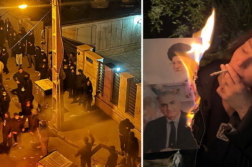
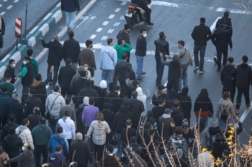
For the past few days, the fire of popular protests in Iran has flared up again, and in many cities we’re seeing gatherings by different sections of society. The latest spark was protests by Tehran’s bazaar merchants, and those in a few other cities, triggered by the rise in the dollar exchange rate. Complaints from bazaar traders about the dollar getting more expensive aren’t new; this has happened before.
What makes the current wave different is how quickly it has spread to smaller towns and to social groups and classes beyond the bazaar.
One important point is that “the bazaar” in Iran isn’t a single, uniform bloc. A large part of the people working there are actually from the lower layers of the bazaar and make up its working poor: small shopkeepers, shop assistants, salespeople, service and transport workers, street vendors, and so on. Their livelihoods depend on the bazaar, but their lives look nothing like the stereotype people usually imagine when they hear the word “bazaar merchant.” So any analysis of bazaar protests has to take this internal class layering seriously; otherwise it turns into vague generalizations and bad analysis. The person protesting in areas like Molavi Bazaar, 15 Khordad, or Jomhouri Street—are they the owner of several shop units or a chain store boss, or are they one of the workers and small-scale earners mentioned above? From what I’ve personally seen, the “real” bazaar elites, even if they’re hurt by the current economy, tend to pull their shutters down during these crises and head off to their holiday homes. It’s others who come out into the winter cold to talk about the soaring exchange rate, the inability to pay rent, and the rising costs of keeping their small businesses alive.
Economic insecurity and instability, lack of contracts and insurance, and the absence of support networks like unions or trade associations are some of the clearest features of these hard-working groups inside the bazaar. And it’s only natural that constant currency shocks and fast-rising inflation push their working lives into an even tighter corner every day.
On top of that, as expected, the bazaar protests acted like a spark on dry tinder. Very quickly they spread to poorer and more peripheral groups in society—both in terms of livelihoods and geography. If we compare a map of these recent protests with a map of the country’s deprived areas, where poverty and inequality are high, we’ll notice that a significant portion of the two maps overlap.
Five days after the protests began, the “Faitox” network marked 72 participating cities on a map. Let’s first look at the names of these cities:
Abdanan, Arak, Urmia, Azna, Asadabad, Esfarayen, Eslamshahr, Eslamabad-e Gharb, Isfahan, Ahvaz, Izeh, Ilam, Babol, Bagh Malek, Bandar Abbas, Bandar Gonaveh, Tehran, Kish, Jahrom, Juyabad, Junqan, Khorramabad, Dezful, Dargahan, Dehloran, Dorud, Ramehormoz, Rasht, Robat Karim, Zahedan, Zanjan, Saveh, Sabzevar, Shush, Shahr-e Kord, Shirvan, Shiraz, Farsan, Fasa, Firouzabad, Fooladshahr, Qazvin, Qom, Kazerun, Karaj, Kerman, Kermanshah, Kavar, Kouhdasht, Gorgan, Gonaveh, Lali, Lordegan, Marlik, Ma’ali Abad, Malard, Malayer, Mamasani, Marvdasht, Mashhad, Najafabad, Nahavand, Nourabad, Neyshabur, Vakilabad, Hamedan, Harsin, Yasuj, and Yazd.
As you can tell from the list, many of these are small towns that a lot of people may not recognize, or may be hearing about for the first time. For instance, I personally know Lordegan because it’s close to my ancestral town, Borujen, in Chaharmahal and Bakhtiari province. But when I asked a few friends about it, they didn’t even know which province it’s in.
This isn’t just a random accident or simple “geography ignorance.” It’s rooted in decades of regional and development policies. Many of these smaller, mostly underdeveloped towns are clustered in the west and southwest of the country. Despite having underground resources—oil, gas, and other minerals—they were largely ignored in development plans. Their unemployed youth and poor, vulnerable elderly were left to fend for themselves. Poverty, inequality, and discrimination piled up year after year, until today, when they’ve come out with demands for justice. And beyond the general economic pressure now affecting virtually everyone, daily life in these regions suggests something even starker: it’s as if these small towns have been abandoned, as if they have no real place in the country’s development agenda.
Where does the crisis really come from?
The roots of the current crisis—the one that has produced the events of the past few days—are historical, structural, and much deeper than something you can fix by replacing a director-general, swapping out the central bank governor, or removing one minister and bringing in another deputy minister. These managerial shake-ups don’t solve the underlying problems. At best, they might postpone them. Because today, in the view of most experts and researchers, Iran’s economic troubles have a clearly political root and go back to the way the country’s political economy is built. Some of these roots aren’t even limited to the past four decades—they’re older than the lifespan of any single government.
Looking at the period after the Iran–Iraq war, every few years a new wave of protest has swept the country: in 1995, the “bread riots” in Eslamshahr, Mashhad, and Karaj; in 1997, the reform movement and public support for political change; in 1999, the student movement around the University Dormitory protests; in 2009, mass protests over the election; in 2017 and 2019, protests centered on livelihoods; in 2022, protests driven by a major social demand—and now 2025. What this timeline shows is that as time goes on, the gaps between these uprisings get shorter. From 2009 to 2017 there was a seven-year interval, but after 2017 the protests moved away from the framework of electoral politics and took on a deeper character—more economic, more social, and more fundamental.
Why this shift happened can be examined through economic indicators and statistics. As the economy was pushed further toward neoliberal restructuring, and as social rights were rolled back—alongside economic sanctions (whose internal and external architects are a long, separate discussion)—social policymaking was increasingly held hostage by upper classes both inside and outside the state. A discourse spread that basically suggested society and the state owed nothing to the unemployed, the elderly, retirees, workers, young people, women, and others. The predictable result was growing pressure on the daily lives of these groups, and a rising sense of anger.
People could see that they were being forced to work more, struggle harder, and yet receive a smaller share of the country’s wealth. And for those living in peripheral regions and small towns, that discrimination was doubled.
At the same time, media tools—and the culture of social comparison they created—gave people a new kind of awareness. They realized that what gets sold as a “general national economic hardship” mostly lands on their lives, while it barely shows up in the lifestyle of the country’s political and economic elite. Every day they’re told to work harder, live more simply, and accept less because the country is under sanctions. But they rarely see that same message reflected in how the powerful actually live. So the gap between the elite lifestyle displayed in the media, the austerity preached from official platforms, and the real hardships falling on ordinary people has become a breeding ground for resentment—especially resentment rooted in lived, visible inequality.
Repeating the past, or opening a real way forward?
During the latest wave of protests, we’ve heard slogans from some groups calling for a return to Iran’s previous political system. Some of what’s circulating is clearly shaped by outside media propaganda, and in some cases even by AI-made content, but you can’t dismiss all of it as fake.
In my view, when you hear these kinds of slogans in protests across smaller towns, it’s less a clear, positive political project and more a reaction to brutal living conditions: the exhaustion and hopelessness they create, the lack of a credible alternative to the current order, and—on top of that—the limited cultural and political development in many of these areas. All of this pushes people into a forced “either this or that” mindset. So they start looking for an escape from today’s structural crisis by imagining a return to an earlier structure—without realizing, first, that many of today’s structural problems are rooted in the same centuries-long monarchical authoritarianism, and second, that no desirable future can be built without a serious critique of the past.
Based on that, any real structural improvement—something that could actually reduce popular anger—depends on social policymakers thinking socially, and on the existence of a political will to repair past damage. Otherwise, whatever is done will, at best, follow the pattern we’ve seen for years: temporarily “managing” protests and pushing them off to another month or another year. And at worst, it will mean refusing responsibility and accountability for people’s demands—and simply repeating the past all over again.
At the end of the day, it’s a choice the policymakers keep making: they can face an ever-growing pile of unmet demands that returns in more openly political forms, respond with a security approach, and merely delay the explosion again—or they can move toward structural reforms that open a genuine horizon for solving these problems.
———————————————————————
* Khosrow Sadeghi Borujeni is a journalist, a labor and social welfare researcher, and a sociology graduate. In recent years, alongside his research on neoliberalism and Iran’s political economy, he has published a number of articles on these topics. Because of his critical stance toward the government’s economic policies—and also for taking part in International Workers’ Day events in Tehran—he was arrested and later sentenced to prison.